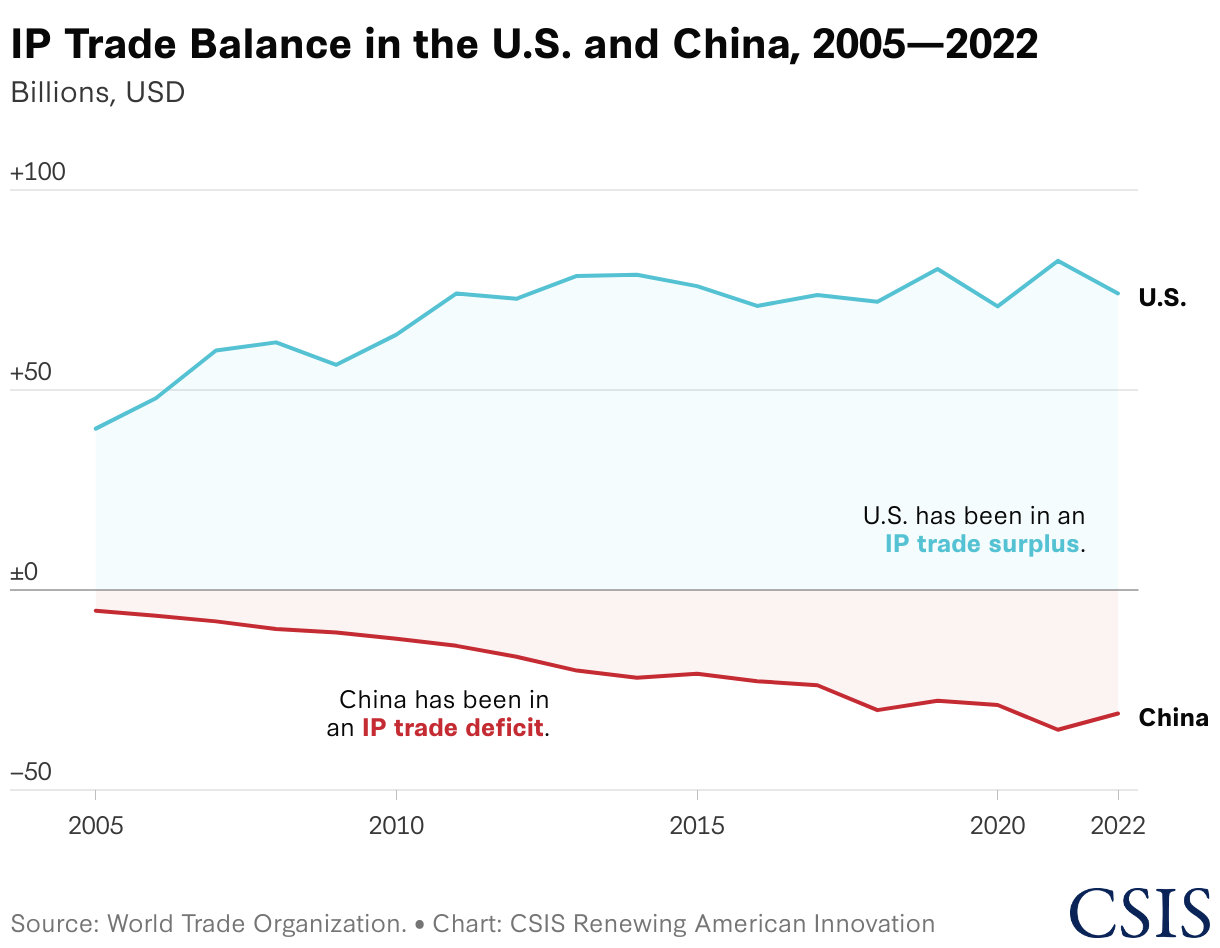
As debates over trade balances intensify, policymakers should remember where the United States already excels: the creation, sale, and licensing of intellectual property (IP). IP rights such as patents, copyrights, and trademarks convert ideas into protected and transferable economic assets, promoting innovation and economic growth.
In the arena of international trade, firms monetize their intellectual assets by selling them outright or, more commonly, by licensing them—that is, granting others permission to use the protected IP for a fee. For example, an innovative firm may license its patented technology or copyrighted software to a manufacturer, who then incorporates the innovation into their products. In this way, the IP-owner earns revenue for their intellectual contribution, while the manufacturer avoids the cost, risk, and challenge of reinventing that technology themselves. IP licensing is a fundamental component of many modern supply chains. Complex products, such as smartphones, can incorporate thousands of patented technologies owned by hundreds of different companies.
Because U.S. universities, laboratories, and companies produce a steady stream of breakthroughs, the United States earns far more from cross‑border IP transactions than it spends. World Trade Organization (WTO) data show that in 2022, U.S. IP owners received more than $127 billion from foreign licensees and buyers, while U.S. entities paid only $53 billion to use foreign IP—a surplus of roughly $74 billion. That performance dwarfs second-place Germany’s $53 billion in IP exports, and contrasts sharply with China’s $31 billion IP trade deficit, highlighting how IP allows the United States to convert its innovative capacity into a decisive trade advantage.
This positive IP balance of trade for the United States underscores two facts. First, ideas—and the legal rights that protect them—are a cornerstone of U.S. economic strength. Second, a well‑functioning global IP system channels foreign revenue back to American inventors, which in turn funds the next wave of breakthroughs. Policymakers should champion and reinforce that system, resisting initiatives that erode patent, copyright, and trademark protections at home or abroad. Doing so will not only preserve a critical trade advantage but also ensure that the United States continues to lead in the innovation‑driven industries that power growth and bolster national competitiveness.
Data visualization by Sabina Hung
This piece was originally published on May 12th with the Renewing American Innovation Project at the Center for Strategic and International Studies in Washington, D.C.
Securing the Future of the U.S. Biopharmaceutical Industry: The Most-Favored-Nation Paradox
February 5, 2026
By Sujai Shivakumar and Anne Pritchett The Trump administration is pursuing lowering prescription drug costs primarily to end what it describes as “global freeloading” and to ensure U.S. patients pay prices comparable to those in other developed nations. The administration argues that while the United States represents less than 5 percent
Universities, Patents, and the Future of U.S. Competitiveness
December 15, 2025
By Shruti Sharma and Chris Borges Universities are among the most powerful engines of U.S. innovation, transforming federal research investments into scientific discoveries that underpin economic growth, technological leadership, and national security. Current law, via the Bayh-Dole Act, allows universities to patent inventions and license them to private companies, with royalties
How Counterfeit Drugs Threaten U.S. Health and Innovation
November 19, 2025
By Anne Pritchett According to the Department of Homeland Security, counterfeit drugs “threaten national security and public safety directly when introduced into government and critical infrastructure supply chains, and indirectly if used to generate revenue for transnational criminal organizations.” Furthermore, counterfeit drugs harm pharmaceutical innovation by eroding profitability and investor