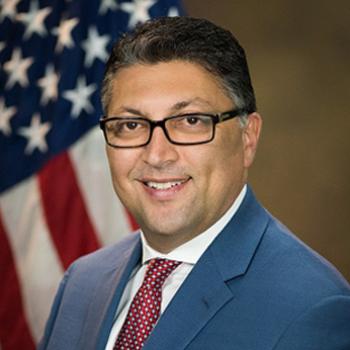
Makan Delrahim

Makan Delrahim is Adjunct Lecturer in Law at the University of Pennsylvania and former Assistant Attorney General for the Antitrust Division, United States Department of Justice.  Mr. Delrahim previously served as Deputy Assistant to the President and Deputy White House Counsel.  Mr. Delrahim’s rich antitrust background covers the full range of industries, issues, and institutions touched upon by the work of the Antitrust Division.  He is a former partner in the Los Angeles office of a national law firm.  He served in the Antitrust Division from 2003 to 2005 as a Deputy Assistant Attorney General, overseeing the Appellate, Foreign Commerce, and Legal Policy sections.  During that time, he played an integral role in building the Antitrust Division’s engagement with its international counterparts and was involved in civil and criminal matters.  He has served on the Attorney General’s Task Force on Intellectual Property and as Chairman of the Merger Working Group of the International Competition Network.  Mr. Delrahim was also as a Commissioner on the Antitrust Modernization Commission from 2004 to 2007.  Earlier in his career, Mr. Delrahim served as antitrust counsel, and later as the Staff Director and Chief Counsel of the U.S. Senate Judiciary Committee.
Securing the Future of the U.S. Biopharmaceutical Industry: The Most-Favored-Nation Paradox

By Sujai Shivakumar and Anne Pritchett The Trump administration is pursuing lowering prescription drug costs primarily to end what it describes as “global freeloading” and to ensure U.S. patients pay prices comparable to those in other developed nations. The administration argues that while the United States represents less than 5 percent
Read More

Universities, Patents, and the Future of U.S. Competitiveness

By Shruti Sharma and Chris Borges Universities are among the most powerful engines of U.S. innovation, transforming federal research investments into scientific discoveries that underpin economic growth, technological leadership, and national security. Current law, via the Bayh-Dole Act, allows universities to patent inventions and license them to private companies, with royalties
Read More

How Counterfeit Drugs Threaten U.S. Health and Innovation

By Anne Pritchett According to the Department of Homeland Security, counterfeit drugs “threaten national security and public safety directly when introduced into government and critical infrastructure supply chains, and indirectly if used to generate revenue for transnational criminal organizations.” Furthermore, counterfeit drugs harm pharmaceutical innovation by eroding profitability and investor
Read More